
As scholarly publishing professionals, we cannot, individually, hold all the knowledge required to uphold responsible publishing practices; this is especially true as the field of publication ethics evolves at what seems to be an exponential rate. As an Ethics Manager, I look to certain organizations to guide my society’s policies—to draw on existing expertise, ensure consistency, and avoid duplicating effort. CSE has excellent resources related to ethics, including DEIA Scholarly Resources,1 various CSE Policies,2 and the Publication Ethics short course3; however, many of us also look to the Committee on Publication Ethics (COPE) for their valued guidance, flowcharts, and case studies.
Of interest to Science Editor readers, COPE recently updated their guidance for retractions4 (version 3) and published new guidance for expressions of concern.5 This guidance is invaluable to those navigating ethical concerns related to older articles that may no longer have original data available. The new guidelines and related flowcharts help to guide decisions and next steps with the ultimate goal of ensuring a body of literature that is credible and reliable. See the recent COPE editorial6 highlighting the relevant changes to their retraction guidelines and overviewing the newly released expression of concern guidelines. The Figure provides a decision workflow for evaluating a concern related to a published article based on the published COPE guidance for retractions and expressions of concern.
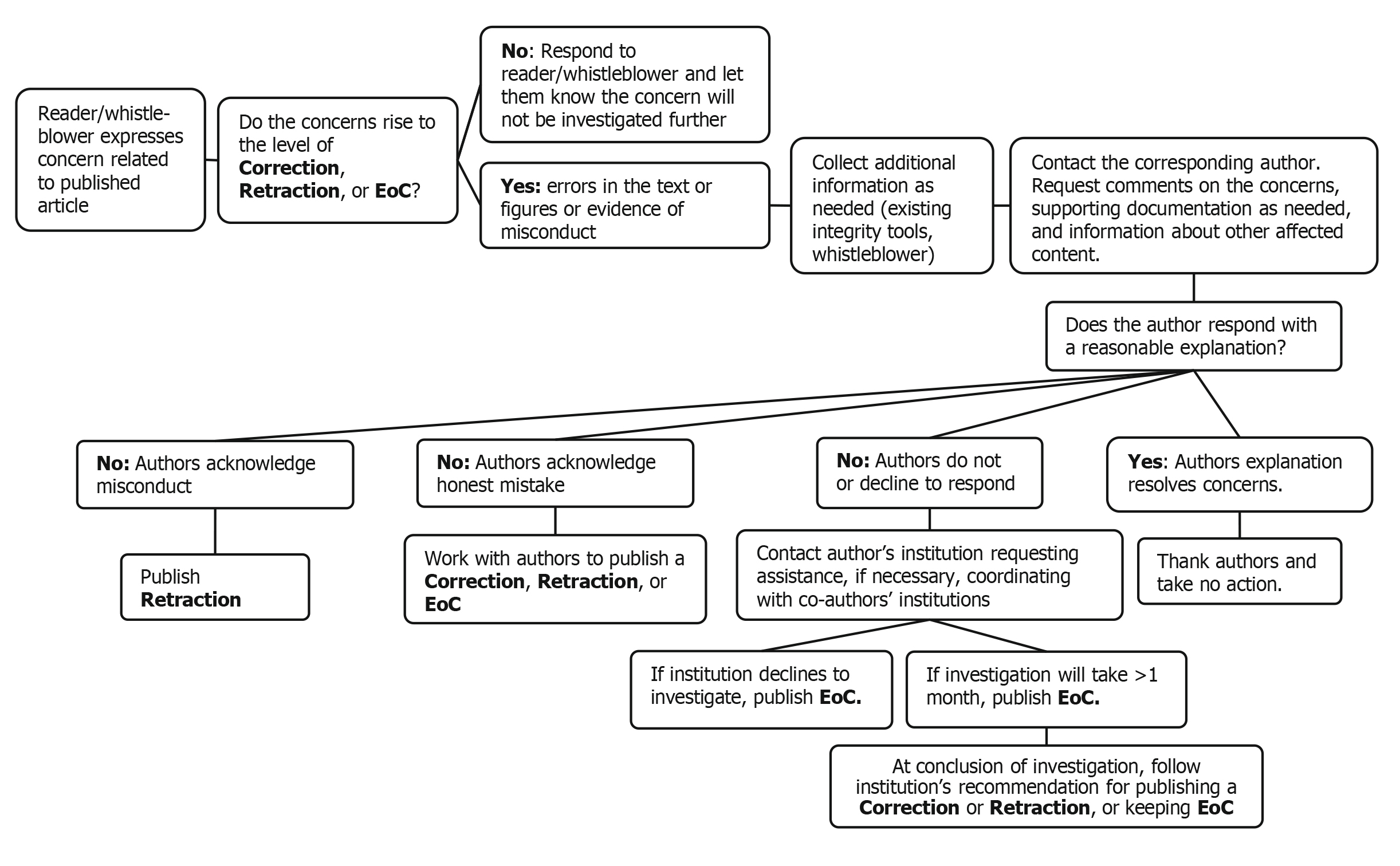
- Criteria for Corrigenda: Small error not affecting the underlying conclusions and not associated with misconduct.
- Criteria for Retraction: Clear evidence that findings are unreliable, misrepresented (e.g., through deception, fraud, identity theft, or undisclosed use of artificial intelligence), or resulting from fabrication or falsification; clear evidence of misconduct (plagiarism, duplicate publication, copyright infringement, unethical research, compromised peer review, failure to disclose major conflicts of interest), authorship cannot be verified or there are serious concerns about accountability for the research; publication includes a meta-analysis or systematic review, the conclusions of which rely on content that has been corrected or retracted.
- Criteria for Expression of Concern (EoC): Significant and credible concerns with inconclusive evidence of misconduct; evidence for misconduct, but institution either declined to investigate or investigation is ongoing; authors have been asked to provide additional information, but this is not immediately available; breach in journal or publisher policy that cannot be resolved (e.g., article data were available at publication but no longer are available).
References and Links
- https://www.councilscienceeditors.org/deia-scholarly-resources
- https://www.councilscienceeditors.org/cse-policies
- https://www.councilscienceeditors.org/short-courses
- https://publicationethics.org/guidance/guideline/retraction-guidelines
- https://publicationethics.org/guidance/guideline/expressions-concern
- https://publicationethics.org/news-opinion/new-and-updated-guidelines-post-publication-review
Kristin Inman is Ethics and Partner Publishing Manager, American Physiological Society.